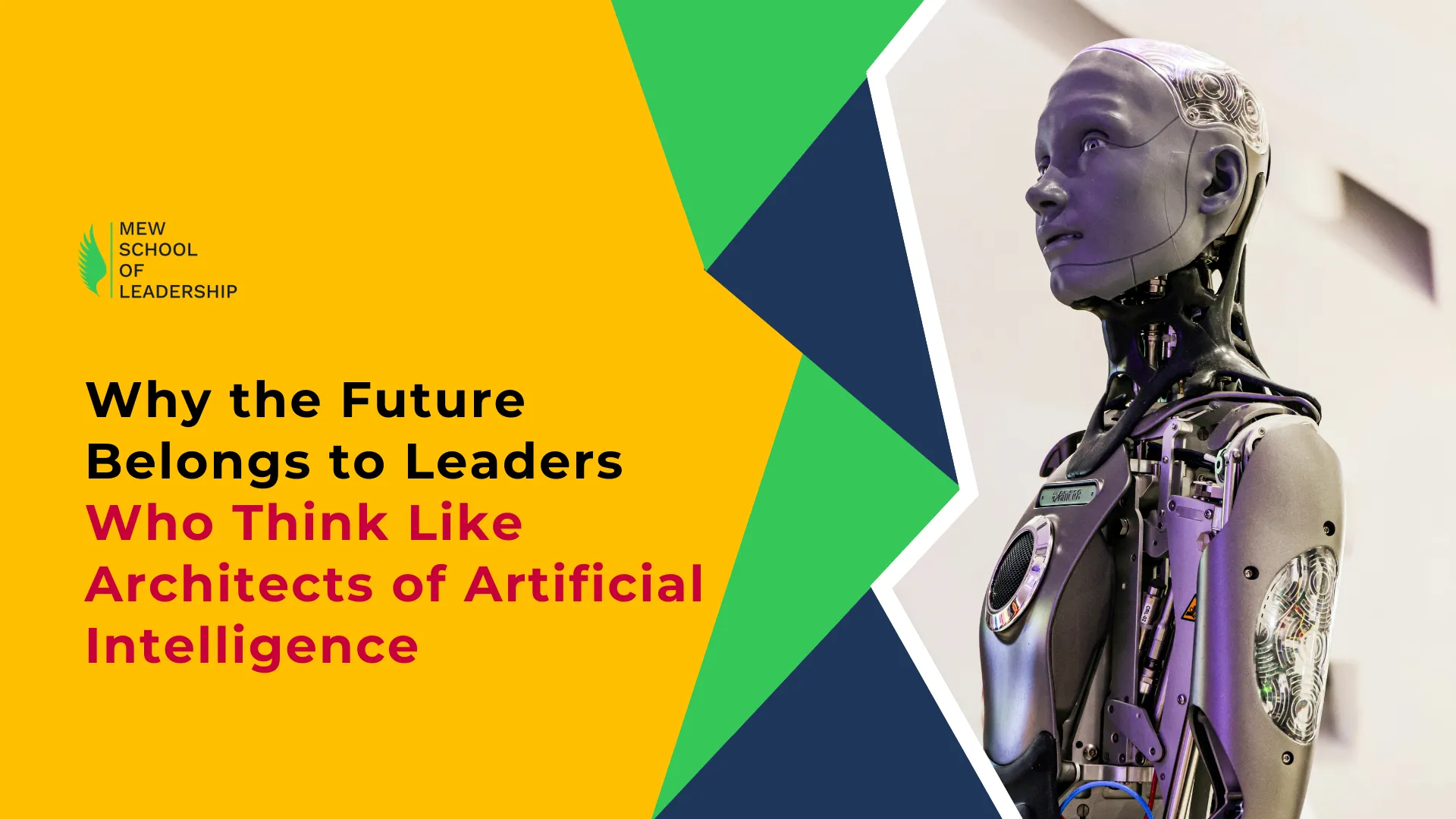
Artificial Intelligence is no longer a futuristic concept. It is rapidly transforming how organizations operate, how decisions are made, and how value is created. Yet while the technology itself is advancing at extraordinary speed, the true differentiator in the coming decade will not simply be AI capability - it will be leadership capability in the age of AI.
Across industries, a new leadership paradigm is emerging. Leaders are no longer merely decision-makers or strategists. They are becoming architects of intelligence, responsible for designing ecosystems where human judgment and artificial intelligence work together to produce superior outcomes.
The organizations that thrive in this era will not necessarily be those with the most advanced algorithms. They will be those with leaders who understand how to harness AI responsibly, strategically, and creatively.
From Command Leadership to Cognitive Leadership
Traditional leadership models were built around hierarchy, authority, and human expertise. In contrast, AI-enabled organizations operate through data flows, algorithmic insights, and continuous learning systems.
This requires what many scholars and executives now call cognitive leadership.
Cognitive leadership involves the ability to:
- Integrate machine intelligence with human decision-making
- Interpret complex data insights
- Manage algorithmic bias and ethical considerations
- Lead teams that collaborate with AI systems
- Adapt rapidly to continuous technological disruption
Rather than replacing leaders, AI is amplifying the importance of leadership judgment. Algorithms can analyze data, but they cannot define purpose, culture, or ethical direction. These remain deeply human responsibilities.
The Rise of the AI-Augmented Leader
One of the most important leadership shifts happening today is the rise of the AI-augmented leader.
AI is transforming how leaders make decisions. Instead of relying solely on experience and intuition, leaders now have access to systems that can analyze massive datasets, simulate strategic scenarios, and identify patterns invisible to the human eye.
For example, AI systems can now assist leaders in:
- Forecasting market demand
- Identifying emerging consumer trends
- Predicting operational risks
- Optimizing workforce allocation
- Simulating strategic business scenarios
However, the most effective leaders are not those who blindly trust algorithms. Instead, they develop algorithmic literacy — the ability to understand how AI works, question its outputs, and apply human judgment when making final decisions.
This balance between data-driven insight and human wisdom is becoming the hallmark of modern leadership.
Ethical Leadership in the Age of Intelligent Machines
Perhaps the most urgent leadership challenge in the AI era is ethical governance.
AI systems are powerful, but they are not inherently neutral. They reflect the data they are trained on and the assumptions built into their models. Without responsible leadership, AI can amplify bias, create unfair decisions, or undermine trust.
Leaders must therefore become stewards of responsible AI.
- Key ethical responsibilities now include:
- Ensuring transparency in AI decision-making
- Preventing algorithmic bias and discrimination
- Protecting data privacy and security
- Maintaining accountability for AI-driven outcomes
- Establishing clear governance frameworks for AI deployment
Organizations that ignore these responsibilities risk not only regulatory consequences but also reputational damage and loss of stakeholder trust.
Ethical AI leadership is therefore not simply a compliance issue. It is becoming a core strategic capability.
Human Skills Are Becoming More Valuable, Not Less
One of the biggest misconceptions about AI is that it will diminish the importance of human leadership skills. In reality, the opposite is happening.
As machines take over analytical and routine tasks, the most valuable leadership capabilities are becoming deeply human ones.
These include:
- Emotional intelligence – understanding and motivating people in complex environments
- Strategic vision – identifying opportunities that machines cannot conceptualize
- Creativity and innovation – imagining new possibilities beyond data patterns
- Ethical reasoning – guiding organizations through moral and societal questions
- Storytelling and influence – aligning people around purpose and transformation
In many ways, AI is pushing leadership back to its essence: the ability to inspire, guide, and make meaning in uncertain environments.
AI Is Redefining Organizational Power Structures
Another profound shift created by AI is the redistribution of knowledge power inside organizations.
Historically, power often resided with senior executives who possessed the most information and experience. Today, AI tools are democratizing access to insight.
A junior analyst equipped with powerful AI systems may now generate insights that once required entire departments.
This means future leaders must focus less on control of information and more on the orchestration of intelligence.
- The leader's role becomes one of:
- Connecting insights across teams
- Enabling collaboration between humans and AI
- Encouraging experimentation and learning
- Creating environments where intelligent systems enhance human creativity
Leadership therefore, becomes less about authority and more about intellectual ecosystem design.
The Strategic Imperative: Building AI-Ready Organizations
Forward-thinking leaders are recognizing that adopting AI is not merely a technological upgrade. It is a strategic transformation.
Building an AI-ready organization requires several leadership actions:
1. Developing AI Literacy Across the Workforce
Employees must understand how AI works, its limitations, and how to collaborate with intelligent systems.
2. Investing in Data Infrastructure
AI is only as effective as the data it learns from. Leaders must prioritize data quality, governance, and accessibility.
3. Creating a Culture of Experimentation
AI innovation thrives in organizations that encourage experimentation, learning from failure, and rapid iteration.
4. Aligning AI With Business Strategy
AI should not be implemented as a technological novelty. It must serve clear strategic objectives such as customer value, operational efficiency, or innovation.
The Leadership Paradox of the AI Age
The AI revolution presents a fascinating paradox.
The more intelligent our machines become, the more human leadership must become.
Technology can accelerate analysis, optimize systems, and automate decisions. But it cannot replace the uniquely human capacity for purpose, empathy, ethical reasoning, and imagination.
The leaders who will shape the future are therefore not those who simply adopt AI tools. They are those who understand how to blend technological intelligence with human wisdom.
The Future Leader: Architect of Human–AI Collaboration
The most successful leaders of the coming decade will act as architects of collaboration between humans and machines.
They will design organizations where:
• AI enhances human creativity rather than replacing it • Data informs decisions without eliminating human judgment • Technology amplifies purpose rather than undermining it
In this new era, leadership is no longer about managing people alone. It is about leading an ecosystem of human and artificial intelligence.
Those who master this balance will define the next generation of innovation, competitiveness, and responsible progress.
Final Thought
Artificial Intelligence is transforming the world of work at an unprecedented pace. Yet the defining question of this transformation is not technological.
It is fundamentally a leadership question.
The future will belong to leaders who can harness the power of intelligent machines while preserving the uniquely human qualities that give organizations meaning, trust, and direction.
In the age of AI, leadership is not becoming obsolete.
It is becoming more important than ever before.