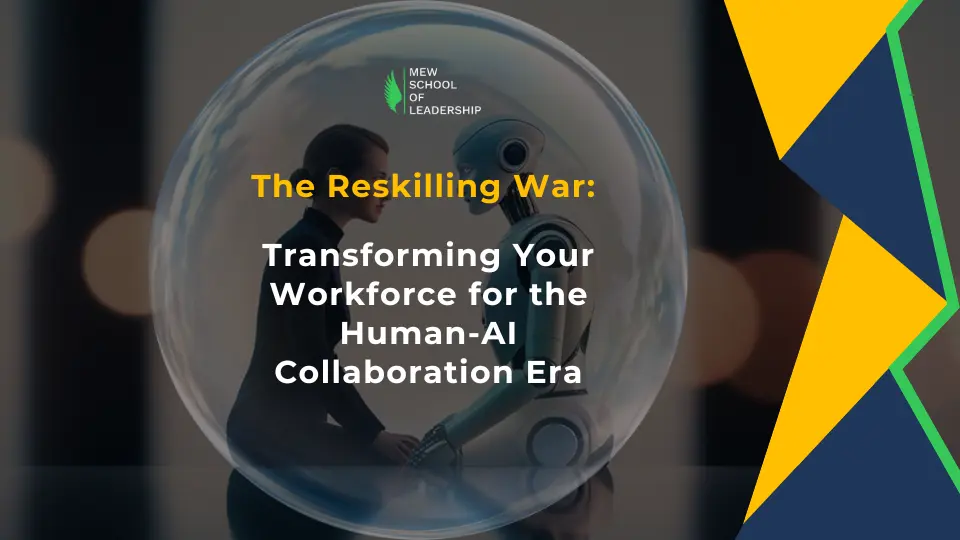
For years, the public debate surrounding artificial intelligence centred on a single, fear-driven question: Will machines replace human workers? As we navigate the realities of business today, that narrative has become demonstrably outdated. The most critical operations in any modern enterprise—those requiring adaptability, ethical judgment, and complex problem-solving—cannot rely on automation alone.
Instead of an era of replacement, we have entered the era of augmentation. The future of enterprise performance relies on humans and AI working in symbiosis. Yet, while the technology is ready, the workforce is not. A staggering 90% of global enterprises are projected to face critical skills shortages this year, with AI-related gaps putting trillions in economic value at risk (IDC, 2026, p. 4).
This is the new ‘Reskilling War’. It is no longer enough to hire a few technical specialists; leaders must fundamentally rewire how their entire workforce interacts with technology. At the MEW School of Leadership (mewschool.com), we recognise that equipping managers to lead this transformation is the defining challenge of our time. Whether you are leading a multinational corporation or looking to accelerate your career with a UK MBA from a premier leadership school, mastering the dynamics of human-AI collaboration is essential.
1. The Death of the Entry-Level Role (and What It Means)
One of the most pressing issues leaders face today is the structural shift in job design. AI is rapidly absorbing the routine, background tasks that historically served as the training ground for junior employees.
Recent workforce data reveals a stark reality: 66% of enterprises are reducing entry-level hiring as they deploy AI, while 91% report existing roles are being partially automated (IDC, 2026, p. 12). If AI is drafting the reports, summarising the meetings, and analysing the baseline data, how do junior employees learn the business?
Leaders must bridge this gap by redesigning roles around distinctly human strengths. We can no longer afford to let junior staff act as data processors; they must be trained to act as AI supervisors and orchestrators from day one (Microsoft, 2026, p. 18).
2. The Premium on Hybrid Skills
The conversation has shifted from teaching people to code, to teaching people to collaborate with algorithms. Workers with AI skills are now commanding wage premiums up to 56% higher than their peers, even in traditionally non-technical fields (PwC, 2025, p. 8).
To win the reskilling war, organisations must stop viewing AI literacy as an IT function. Every employee needs a baseline understanding of how to interact with intelligent systems.
| Human Strengths (To Cultivate) | AI Capabilities (To Leverage) | The Collaborative Outcome |
| Contextual judgment and empathy | Real-time processing at scale | Nuanced customer service |
| Strategic reasoning and creativity | Pattern detection in massive datasets | Rapid, data-backed innovation |
| Ethical oversight and accountability | Consistent execution without fatigue | Safe, compliant operations |
When evaluating talent, Globally recognised UK Degrees and top-tier programmes at a UK Business School are increasingly embedding these hybrid competencies into their curricula, ensuring graduates are ready to manage these collaborative workflows.
3. A Practical Playbook for Reskilling Your Workforce
How can leadership transform their workforce before the skills gap becomes a critical operational failure? Follow these practical steps to initiate a successful reskilling campaign.
Step 1: Conduct a Task-Level Audit
Do not look at whole jobs; look at the tasks that make up those jobs. Identify which highly repetitive tasks can be delegated to AI agents. Then, map out the strategic tasks your employees should be doing with the time they get back.
Step 2: Implement ‘AI Fluency’ Programmes
Move beyond generic software training. Your workforce needs practical, role-specific fluency. This includes:
-
Prompt Engineering: Teaching employees how to ask the right questions to get high-quality outputs.
-
Output Validation: Training staff to spot hallucinations, biases, and logical errors in AI-generated work.
-
Workflow Integration: Showing teams how to hand off tasks to AI and when to step back in to take control (Mindbreeze, 2026).
Step 3: Redesign KPIs Around Collaboration
If you measure your employees solely by traditional output metrics, you will disincentivise AI adoption. Organisations that track and optimise how well humans and AI collaborate—measuring decision speed, innovation rate, and output quality rather than raw hours worked—are projected to see significantly higher profit margins over the next three years.
Takeaway for Leaders
The central takeaway for executives and HR leaders is that human-AI collaboration is the new default operating model for knowledge work. The winners of the Reskilling War will not be the companies that buy the most expensive AI tools, but those who invest relentlessly in human adaptability. Treat AI as a force multiplier for human ambition, and prioritise continuous learning to ensure your team remains the most valuable node in your operational network.
Reference List
- IDC (2026) Work rewired: navigating the human-AI collaboration wave. Available at: https://www.idc.com/resource-center/blog/work-rewired-navigating-the-human-ai-collaboration-wave/ (Accessed: 1 July 2026).
- Microsoft (2026) Work trend index 2026. Available at: https://www.microsoft.com/en-us/worklab/work-trend-index (Accessed: 1 July 2026).
- Mindbreeze (2026) The new collaborative era: humans + AI in 2026. Available at: https://www.mindbreeze.com/blog/the-new-collaborative-era-humans-ai-in-2026 (Accessed: 1 July 2026).
- PwC (2025) Global AI jobs barometer. Available at: https://www.pwc.com/gx/en/issues/artificial-intelligence/ai-jobs-barometer.html (Accessed: 1 July 2026).